Two years ago I bought a new car, not a second hand vehicle as is the norm in New Zealand, but a genuinely new European car. It came with its usual Teutonic pedigree and a guarantee that it would perform without problem.
Two days ago, the small plastic grab handle for the driver's seat adjustment gave into the strain with a loud crack, propelling me backwards and leaving me with a handful of plastic shards.
Why was this so mortifying? Firstly the factor of the unexpected release which propelled me backwards into my seat. Secondly was the growing realisation that the part in question was grossly inadequate for the purpose to which it was put.
A thickness of two or three millimetres of plastic was never going to last the distance and so it proved. What to do?
Fortunately a new car comes with a warranty and in the case of our model this was for three years. So I dutifully made a temporary repair with a bandage of used rubber bands and called the dealer.
It is here that I must give kudos to the Service Manager of my local franchise. Often the term "service" in a title means anything but. In this case he couldn't have been more obliging, agreeing that the offending plastic was inadequately designed for the job, and giving me a replacement free of charge.
To be frank I would much prefer to travel by public transport as I did in Singapore. Yes, there has been the occasional and frustrating MRT failure in recent times but at least there is an MRT to fail!
Now come the news that Singapore and KL are going to be linked by a high speed train. The planned service includes stops in Johor, Malacca and Negeri Sembilan. Pity there is no stop mooted for Ipoh; giving passengers the chance to stock up on some of their famous kueh kueh.
Showing posts with label Malacca. Show all posts
Wednesday, 20 February 2013
The Sum Of Its Parts
Labels:
2013,
high-speed,
Johor,
Malacca,
Mass Rapid Transit,
MRT,
Negeri Sembilan,
New Zealand,
Plastic,
rail,
Roger Smith,
Singapore
Saturday, 28 January 2012
The Cycle of Decay
One tends not to associate concrete, that most solid of building blocks, with decay. It is after all inorganic, unlike nature which encroaches upon it.
My trips to Asia in the 1980's brought home to me that concrete was no different from wood or any organic element; each was subject to the cycle of erosion and decay, it is just a question of time.
A first trip to Europe a decade was equally fascinating as layers of civilisation were stacked one upon the other, each using as its base the remnants of what had come before.
One enduring image I have kept with me are the remains of a mansion gate in Singapore's Oxley Road (incidentally the section address is 2 Lloyd Road as it is on a corner), named after Dr Thomas Oxley,the colony's surgeon from 1827 and just a little further up the incline past Lee Kwan Yew's home.
I walked past this post regularly during our trips back to Singapore to see family; past the Gurkhas guarding the former PM's home. These treks took place from 1986 to 2006, after which time we were living in Singapore ourselves.
Each time I walked past it the post looked a little more decrepit and overgrown in its constant battle with creepers and vines of varying thicknesses. Singapore being a tropical country has a heavy rainfall and warm sunshine all year round which means that buildings weather rapidly. Rain, wind, solar radiation including ultra-violet light and atmospheric pollution all take their toll.
It turns our that these gates and and empty section are all that remains of the grand house, Villa Austerlitz. Singapore's National Archives has some very good images of the house at it was and the former owners.
One 1913 photograph clearly shows the same post at left of the picture. The National Archives are a wonderful resource and the staff there do a tremendous job in recording and preserving documents and images associated with Singapore's history. One can even send a historic post card of early Singapore to a friend using their resources.
It is the textural qualities of decay that makes it so appealing through the lens - layers peeled back like an onion to reveal something of interest underneath. This street poster from a visit to Malacca is another such example.
My trips to Asia in the 1980's brought home to me that concrete was no different from wood or any organic element; each was subject to the cycle of erosion and decay, it is just a question of time.
A first trip to Europe a decade was equally fascinating as layers of civilisation were stacked one upon the other, each using as its base the remnants of what had come before.
One enduring image I have kept with me are the remains of a mansion gate in Singapore's Oxley Road (incidentally the section address is 2 Lloyd Road as it is on a corner), named after Dr Thomas Oxley,the colony's surgeon from 1827 and just a little further up the incline past Lee Kwan Yew's home.
![]() |
| Gate Post - Oxley Road near the corner of Lloyd Road Roger Smith |
Each time I walked past it the post looked a little more decrepit and overgrown in its constant battle with creepers and vines of varying thicknesses. Singapore being a tropical country has a heavy rainfall and warm sunshine all year round which means that buildings weather rapidly. Rain, wind, solar radiation including ultra-violet light and atmospheric pollution all take their toll.
It turns our that these gates and and empty section are all that remains of the grand house, Villa Austerlitz. Singapore's National Archives has some very good images of the house at it was and the former owners.
One 1913 photograph clearly shows the same post at left of the picture. The National Archives are a wonderful resource and the staff there do a tremendous job in recording and preserving documents and images associated with Singapore's history. One can even send a historic post card of early Singapore to a friend using their resources.
![]() |
| Villa Austerlitz with the entrance post at left Source: Singapore National Archives |
![]() |
| Posters - Malacca Roger Smith |
Labels:
1913,
1982,
2012,
concrete,
decay,
history,
Lloyd Road,
Malacca,
National Archives,
Oxley Road,
Roger Smith,
Singapore,
Villa Austerlitz
Friday, 10 September 2010
Prints From The Past
Posters - Malacca ................................................................ Roger Smith 1982
I first travelled through South East Asia in the early 1980's and this print reflects and celebrates the exotic (to me) textures, sights, smells and sounds the enveloped me at that time.
The prints are scans of old 35mm transparencies which now only exist in this digital form.
Labels:
Asia,
Malacca,
photograph,
Prints,
Roger Smith,
Southeast Asia
Saturday, 15 May 2010
A Modest Hero
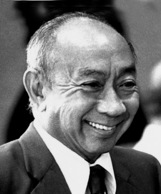
While most people naturally associate the modern miracle that is this country with Lee Kuan Yew, equal kudos should be give to Dr. Goh Keng Swee.
The combination of Lee's political savvy and Dr Goh's 'can do' attitude and economic acumen, made for a winning combination.
A graduate of the London School of Economics, Goh Keng Swee was the government's first finance minister but his influence extended far beyond this initial portfolio. He founded Singapore's army and introduced National Service, a move at that time which did not meet with universal approval as the thought of a precious son being called up was a step too far for some. However, as in most things, his vision proved to be the correct one.
Born into a wealthy Straits Born Chinese family in Malacca he moved with his family at the age of two to re-establish themselves in Singapore. His father later became manager of the Pasir Panjang rubber estate.
Apparently he had a dislike for his Christian name Robert and he shared this trait with his later collaborator Lee Kuan Yew, whose Christian name is Harry.
Keng Swee was a shy boy who buried himself in books but this quest for knowledge and ideas was the building blocks upon which he built his life.
Singapore zoo, Jurong Bird Park, Sentosa and the Singapore Symphony Orchestra were all formed under his stewardship.
His official biography states that he left politics in 1984 for personal reasons. I am informed by people around in the '80's that he had a marked divergence of opinion with his colleagues on using the people's CPF money to fund the soon to be launched MRT system. Whether this had an influence on his departure I do not know but being a man of principle, I suspect that it did.
The MRT has since developed to be Singapore's most important public transport system so these fears proved to be unfounded. But at the time it was first promoted, investing in this transport scheme was perceived by some to be a risky venture.
After leaving the Singapore political scene he was invited to provide guidance with housing policy development in China. I am sure that country will also be mourning his passing.
So I, like others this week, are paying tribute to a man who we never met in person but whose country we now enjoy thanks to his dedication and vision.
Subscribe to:
Posts (Atom)