Showing posts with label United States. Show all posts

Monday, 22 September 2014

Counting Wealth But Not Health

According to an article in Singapore's Straits Times there are thirty two billionaires in Singapore and increase of five over the previous year.

They share a combined wealth of US$65 billion.  What is revealing is the patriarchal nature of Singapore business, which remains very much a tradition within the country and its wealthiest families.

As this graphic shows, none of 32 billionaires are women and most of the money is, and has been, made in the financial sector.  The majority of these super wealthy are not born and bred Singaporeans but have moved there (or their families have) to take advantage of the country's growth and prosperity.


But whether they are a healthy lot is quite another matter with only a quarter showing any interest in health and wellness.  The drive to succeed I would suggest often overcomes any concerns of physical well-being.  That said,  as they have the money to buy the best medical services available, many of these folk enjoy a reasonable life span; the average age of these billionaires being sixty two.

The global trend shows a 7% growth in the number of billionaires and there are now 2,325 of them according to recent research from Wealth-X and the Swiss bank UBS.

12% of the world's billionaires are women and more than half are self-made. i.e. they did not inherit their fortunes.  The old saying about 'money makes money' holds true as most enjoyed an average growth in their wealth of 4.4%.

Even though Singapore is enjoying good growth in the super-rich club the best place to make your fortune remains the USA with China coming a close second.

Thursday, 14 August 2014

The American View - Singapore As The Social Laboratory

The Social Laboratory
Singapore is testing whether mass surveillance and big data can not only protect national security, but actually engineer a more harmonious society.


The US commentator has a grudging respect for the technology but worries about the apparent lack of government accountability/ public safeguards.  

I am not sure I agree with his view, but the trade-off on so-called US freedoms is Singapore's political and security stability which has allowed it to global weather financial storms and develop at an amazing rate of the past 49 years.

Tuesday, 13 August 2013

Still A Visionary After All These Years

One thing is sure; even in his advancing years, Lee Kuan Yew is still as sharp as a tack and remains a great futurist.

I found his observations on the emergence of China as the world's number one global superpower of interest.  It's a country that always plays the 'long game' quietly getting where it wants to go without too much fuss.


While I haven't yet read his new book "One Man’s View of the World " I look forward to doing so, having read many of the previous ones in Singapore.
Enhanced by Zemanta

Saturday, 4 May 2013

Safer and Cheaper in Singapore

For those of us who have money in a bank it is always somewhat reassuring to find that the bank that you trust, is not likely to fall over any time soon.

Good news then for Singaporeans as OCBC has retained its title as the world’s strongest bank for the second year in Bloomberg's latest research.

United Overseas Bank Ltd. (UOB) comes in number seven and DBS at number eight thanks in a large part to the steady Singapore economy and an aversion to risk.  Mind you, the interest deposit rates for term investments in the Republic are fairly minuscule when compared to other countries, but you can't have it both ways.

Not only are the banks more secure but the cost of living, based on a global index of recognisable US consumables, shows that Singapore is much cheaper to live in than say Australia, the USA or the UK.

Hong Kong has greater purchasing power parity than Singapore.  Mouse over the charts to see the figures.


Enhanced by Zemanta

Sunday, 31 March 2013

From Sweetness to Blinding Light

When I was at primary school in Waitara we went on a  field trip to visit a hexagonally-designed house belonging to a family of bee-keepers, the Brewsters.   To say they were fixated by by all things "aparian" would be an understatement, but is turned out to be one of the sweetest trips of my childhood.

Edgar & Nettie Brewster stand at the front door of 'Norian', 36b Sanders Avenue, New Plymouth
Honey tasting certainly has a lot to commend it. As a seven year old I learned for the first time that the tins of honey we got from our local bee-keeper were just one variety and that there were several more that could be enjoyed.  It just depended on what flowers the bees were visiting at the time.

In this age when the properties of New Zealand's manuka honey are known throughout the world this revelation might seem a little strange, but at the time the darker honeys such as manuka and rewarewa were regarded as second rate to the creamy white clover honey.

The facts that bees could starve in winter and were fed supplementary sugar syrups to see them through was another fact I learnt at the time.  But the information that resonated most and has stayed with me all these years, is that the drones (male bees) are kicked out of the hive in Winter and die.  As a young male of a different species I wasn't so sure that this idea was a good one; being surplus to requirements was not something I had ever contemplated before.

This then was my first exposure to the word "drone" and its deathly connotations. Regrettably in recent years the term has come to be associated with high tech weapons that reign down death on the unsuspecting.  Am I alone in thinking that there is something inherently immoral in this type of warfare.  That a technician in the USA, or a country neighbouring a trouble spot, can monitor and wipe out a target from afar might seem a clever solution.  After all, the attacking party faces no risk as the drones are unmanned.

The problem is of course that this is an indiscriminate act of war.  The targeting can be anything but, and prone to human error.  It might save a soldier's life who is delivering the payload but it has often ended the lives of innocent civilians in the process.

I came across this sobering visualisation which shows the proliferation of drone attacks from the first recorded on in 2004.

Out of Sight Out of Mind - web site
Drone manufacturers are now facing an increased challenge as the US Military scales back its operations.  Increasingly they are turning to the manufacture of industrial and civilian drones to boost their profits.

As the ABC reports some of these flying machines are as small as a humming bird and can steer water and pesticides to crops with precision, saving farmers money while reducing environmental risk. They can inspect distant bridges, pipelines and power lines and find hurricane victims stranded on rooftops.

And they are a boon for the would-be spy as the miniaturisation of technology means that they can be manufactured to actually look like insects and hummingbirds. One such device even made it to TIME's list of the top 50 inventions for 2011 (see video below).


Privacy (or the lack of it) from these civilian drones is a major issue. The US is moving to legislate their use  and if you thought the recent News of the World media spying saga put journalism in the gutter, just think what drones will do to our private lives.

According to another recent ABC News report, professors at the University of Missouri have started a “Drone Journalism Program” to teach their students how to use drones as reporting tools!

Students “learn to fly them, and also do what reporters do: brainstorm ideas, go out and do reporting, do drone based photography and video,” professor William Allen told the reporter. “We're trying to see if this is going to be useful for journalism.”

As I write the season of winter is approaching the southern hemisphere.  I can't help but thinking that maybe the bees have the right approach when they force their drones out; sending them to a seasonal and certain death.  Perhaps man can learn a thing or two to from nature after all.
Enhanced by Zemanta

Sunday, 24 March 2013

Sunny Side Up

umbrella

They all laughed at Christopher Columbus when he said the world was round... or so say the lyrics of a popular song.

There was equal hilarity whenever I raised my small umbrella to beat off the Singapore sun. My colleagues used to rib me about this practice but I found it a good way to circumvent 'mad dogs and Englishmen' syndrome.

While certainly not trying to emulate a Tai Tai with her parasol, my small 'brolly with its silvered reflective upper panels worked a treat.

The heat of the noon day sun in Singapore is unmerciful and even the locals wisely avoid it if they can.

I feel totally vindicated today as a recently release study  has shown that 'any fully-functioning handheld umbrella can block more than three-quarters of ultraviolet (UV) light on a sunny day.'

Apparently, and according to the same source, black ones do even better, blocking at least 90 per cent of rays'.  Now I find this somewhat surprising as my rudimentary physics lessons from high school days drilled into me that the colour black attracts heat while white repels it.

The report went on to note that 'the handheld umbrella (HU) is a commonly employed method of sun protection by women in many countries in Asia (45% in China) and the Middle East. In Turkey, hats and umbrellas were found to be the most common photoprotection accessories.

In the 18th and 19th centuries in the United States and in Europe such umbrellas were standard outdoor accessories for women, but by the 20th century sunscreen, hats, and sun-protective clothing had taken over.

As we have become more aware of the harmful effects of UV, the hand-held umbrella is making a comeback.  In both Australia and New Zealand the incidence of skin cancer is particularly high but in both countries it is rare to see a hand held umbrella being used as protection, unless of course it is a new immigrant from Asia.

Large beach umbrella when basking in the sand have been the norm for decades but they hardly qualify as  being 'sun smart'.

I content myself in the knowledge that I was ahead of my time when I first raised my umbrella for a stroll down Tanglin Road!
Enhanced by Zemanta

Tuesday, 7 August 2012

Little Green Glowing Men

For the past few decades New Zealand has been "Nuclear Free'. A bit of a misnomer really as there is nuclear material in the country in small research labs, but never the less a political position that had its genesis in the destructive nuclear testing in the Pacific, most notably by France and US.

While am not a rabid anti-nuclear campaigner, I think most New Zealanders are supportive of the stance. There have been& political repercussions, most notably the downgrading of our status with the USA from 'ally' to 'friend'. Only in recent times and administrations has there been a thaw in the relationship with the NZ Navy (what's left of it) rejoining strategic military exercises with the US. But nuclear-fueled& vessels are still not allowed in new Zealand ports.

This has not stopped the Americans putting their nuclear fuel rods to other forms of propulsion. The latest is nuclear-driven vehicle which has just been dropped on to the surface of Mars. If there is any life on the planet I hope it is staying well away from the batteries. Little Green Men might run the risk of becoming Little Green Glowing Men if they don't.


One of the first images taken by NASA's Curiosity rover, which landed on Mars early Monday, August 6.  The clear dust cover that protected the camera during landing has been sprung open. Part of the spring that released the dust cover can be seen at the bottom right, near the rover's wheel. Photo: NASA.

Frivolity asides, this is a marvelous scientific and engineering accomplishment.. To travel for 9 months across billions of miles (without accruing any airpoints) and to land on the surface of the Red Planet takes some doing.

Given the form of propulsion for the Mars vehicle (nuclear rather than solar) the life expectancy of the craft could be several years, yielding a wealth of scientific results. One hopes that the fuel rods powering the vehicle are using the latest technological innovations. Traditionally a 'spent' nuclear rod has only used 5% of its potential power.

Scientists at the US Department of Energy’s Argonne National Laboratory now think they have found a way of utilising the remaining 95% of the uranium in the fuel rod. Their technique could produce hundreds to thousands of years worth of carbon free energy just by reusing the uranium that has already been mined, and is currently considered ‘spent’.

Mr Brown's Singapore version of the Mars Landing!
Enhanced by Zemanta

Tuesday, 24 July 2012

Do I Smell A Plastic Rat?

Coming up for air?
I am not quite sure how I should react to the news that Caltech and Harvard University scientists in the US have bioengineered a "jellyfish" that can swim.

The 'creature' is made up of silicone polymers and rat heart cells.  That's a plastic ratus ratus to you and me. But unlike the often maligned Gunther Von Hagens variety, these plasticised animals actually have a life, but to paraphrase Star Trek, "Not as we know it".


The Medusoid, for that is its name, is designed to be a biological pump and to assist with heart surgery. 

The process according to my local newspaper, was to use a sheet of cultured rat heart muscle which contracts when electrically stimulated in a liquid environment.  It is the perfect raw material to create the jellyfish according to the researchers..

A silicone polymer was then used to fashion the sheet into a thin membrane that resembles a small jellyfish, with eight arm-like appendages.

Medusoid was then placed in container of salt water and shocked into swimming with synchronised muscle contractions that mimic those of real jellyfish

Kevin Kit Parker who was the project's bio-engineer has quipped that "The world needs less rats and more jellyfish, so I thought it would be cool to do a one-for-one swap".

Now he has his sights set on a different and larger animal to mimic using these processes -  perhaps a politician with a plastic brain or a banker with a plastic heart?  

Come to think of it, my banker already has one.

Enhanced by Zemanta

Thursday, 5 January 2012

The First Cut Is The Deepest?

The Singapore Government has clearly been taking note of the 2011 Election results and the voters dissatisfaction with the high level of remuneration that local politicians receive in the Republic.

There is a reason for these salaries which are the highest in the world; they are currently pegged to the salaries of the top 48 from six industry sectors.

The new proposal (and it is just a proposal at this stage, not law) is to extend this benchmark to the top 1,000 across all industries. i.e. the median income of the top 1,000 Singaporean earners.  Mind you, there is also a ' 40-per-cent discount to "signify the sacrifice that comes with the ethos of political service" clause' which rather dissipates the political or real effect of any pay cut.

The President will be hit hardest with a 51% decrease but I am sure will live quite comfortably on the remaining S$1.5 million.

Even with a 36% cut, Prime Minister Lee Hsien Loong will remain one of the highest paid politicians in the world at S$2.2million ($US1.7 million). By comparison, US President Barack Obama earns about $400,000 and the British PM about $US 270,000.

Post-pay cut, the PM's new salary will still be three times that of the Hong Kong chief executive, Donald Tsang, the world's next highest paid political leader, who earns about $550,000.
How the salaries will compare after the pay-cuts
The least a Minister at the lowest entry level grade would expect to get is $S935,000.  According to TodayOnline their salary will now comprise a fixed component of 12 months' pay and a traditional 13th-month Annual Wage Supplement (bonus).

The individual bonus is based on the minister's performance as determined by the Prime Minister while the National Bonus will be linked to "the socio-economic progress of average and lower income Singapore citizens".

Source - Report on Salaries for a capable and committed Government (TodayOnline)
While the international press is is offering scant praise ito news of the pay cuts, it needs to be remembered that the rational behind the high salaries in the first place was to entice the best professional candidates into politics.

This might be a fine idea in times of economic bliss but when recession bites, as it has in Singapore these past two quarters, the voters find such largesse difficult to stomach. This in combination with MRT problems, housing price rises and taxi woes points to challenging times ahead.  The income of Singaporeans in the bottom fifth has been flat or negative in the 10 years to June 2010 while politicians salaries have soared since the 1990's.

But I wonder if all the above truly reflects the cost of a politician?  Making judgments on salary alone is insufficient.  A 'total cost of office' should include salary, entertainment, total travel, pensions and personal security costs, to name but a few.

If such an equation was in place then the true comparison between US President's cost and those of the Singapore PM would be dramatically different.  Having seen the US President's advance security sweep in action before a planned visit, I can vouch that these are thorough and the costs considerable.

Bottom line which only the voters can answer -  are you getting value for your money?
Enhanced by Zemanta

Monday, 12 September 2011

Premonitions?

A decade ago on September 11th. I arrived at my office in AUT and learnt of the news of the Twin Tower tragedy.

Its imagery remains with me still as does other seminal events such as the assassination of then President Kennedy and man walking on the moon for the first time.

Earlier generations had their own memory imprints; the declaration of war, Pearl Harbour, the airship Hindenburg disaster and the Holocaust amongst them.

In 1985, the wife of one of my best friends suffered a terrible accident when the mini car her husband slipped off a jack as she was underneath, holding a brake lining. Two things I remember vividly from this episode which left her facially disfigured but thankfully alive.

The first was my friend telling me how he somehow was imbued with 'supernatural' strength at the time and lifted the car from her unaided, in one movement. The second is that I painted a small shroud-like study in which I portrayed a devastated space, as my emotional response to what had happened.

Study - 1985
Roger Smith - mixed media on board
It was not a great painting - rough and deliberately crude in its intensity and muslin drapery. What I could never understand is the intuition that led me to include two towers as the central motif, viewed across an expanse of water?
Detail
On the afternoon of September 11th, 2001 I looked again at the image stored on my hard disk drive and wondered whether it was pure coincidence that I had produced this work featuring a city I had never visited, with its dark twin towers featured and a fiery sky? Or was it a premonition of events to come?
Enhanced by Zemanta

Saturday, 13 August 2011

The Presidential Check List

Choosing a President is never an easy task as many of my Singaporean friends will no doubt tell you.  Later this month they go to the polls once again; this time to choose President Nathan's replacement.

I confess to be living back in a country that doesn't have such an office.  We cling to the last vestiges of our colonial past with a Governor General as our Head of State and the Queen's representative.  There are those who would like to replace the G.G. with a President but I am not one of them.  This preference is based on my observations of the shenanigans that surround the presidential electoral process in other countries -  the States and Italy being amongst the worst examples.

Despite my reservations I couldn't help but wonder what my own checklist for picking a suitable President might be?  I have come up with the following:

  1. Pick someone who hasn't been born with a silver spoon on their mouth.
    A man of the people needs to have been fully immersed in the day to day life of the community through face-to-face service throughout their working life. Only then can they truly claim to be the people's president.
  2. Removed from Government machinations
    Even though the presidential role is largely ceremonial a President need to be perceived to be clearly aside from the ambitions of the government of the day, and to have been so for some considerable time.  Not out of touch nor diametrically opposed to those in power, but able to provide the necessary impartial political checks and balances as and when required.
  3.  Sound moral fibre
    A predilection to the demon drink and chasing hotel maids (or airline stewardesses) might be seen as an attribute in some European countries but it does not project the country in the best light and such a candidate should be discounted with alacrity. And don't be lulled by the false sense that the average age of most presidential hopefuls is at least seventy; many still have the libido to make themselves a nuisance if they are that way inclined.
  4. Gravitas
    Pomp without pomposity should be a defining attribute.  The ability to carry out Presidential ceremonial duties with the dignity of the office in tact I see as essential.  A mumbling moron with a slouch, one who doesn't know his knife from his fork simply will not do.
  5. Fiscal Prudence
    If your Presidential salary is in the millions and you banquet by candlelight most nights of the week it could be very easy to lose touch with reality.  Someone who has been able to manage a family budget in reduced circumstances would have the edge when it came to my pick.  If they knew where the best value for money chicken rice was in the Heartland, even better!
As to the Singaporean election we can be assured of one thing; the next President will be a President Tan.  The questions remains, which one?

Enhanced by Zemanta

Friday, 10 December 2010

A Hole In Geylang

Stories in the Republic must be few and far between if a pothole occupies the minds of Singaporean media; albeit a growing subsidence.


At a time when the world is focussing on student anarchy in Britain, the arraignment of WikiLeak's founder Julian Assange and the "Not So Nobel Prize", it is hard to see why a hole in Geylang should prove attractive?

Subsidence is after all not something new in Singapore.  The MRT and road tunnelling has produced subsidences in the past that have been far more spectacular.

In June of 2008 Marina Boulevard developed a five metre wide despression to the consternation of some citizens.

I have always marvelled at the levels of tunnels in the MRT especially where the various lines intersected at stations. Quite an engineering achievement.

In New Zealand we specialise in large holes which people through money into.  In most parts of the world  these are called ponzi schemes and just yesterday, a couple were charged with fleecing Kiwis out of $15 million.

These are minor glitches if one compares the 10 per cent of the entire stock of US currency on this planet which is unusable after printing problems in manufacture produced defective notes.  They are the also first bills to have Preident Obama's signature on them which is not exactly a good omen for the future.

A small hole in Geylang doesn't seem so bad after all.
Enhanced by Zemanta

Thursday, 3 June 2010

Hot Diggety Dog

Just when you thought the age of mass consumerism had peeked, along comes a product that is so profoundly useless it almost defies definition.

Introducing the Ocotdog Frankfurter Converter (I kid you not!).

This mindless piece of plastic converts a perfectly good frankfurter sausage into something grey with splayed 'legs' that straddles your plate.

I marvel at man's ingenuity; imagine the hours of design process that went into this marvel of creativity.

It is apparently is not a new device, so there must be a factory in China still churning them out.

As an aside, I also learnt that hot dogs are identified as a health problem for young children by John Hopkins University. Evidently they choke on them. Imagine what they will do with the Octodog.

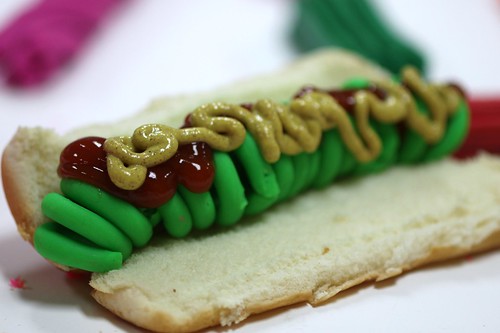
Whole design departments address the American fixation with this humble weiner as the Hot Dog Redesign Exploration (below) bears testament,


Why would anyone in their right mind want to eat something that looked like this?

Franfurter sausage buns are popular in Singapore although most a made with chicken sausages to meet halal standards and appeal to the Malay market.

If you want to sample good sausages at a reasonable price in Singapore, try Marche's restaurant in the 313@Somerset mall in Orchard Road.

One final word about useless contraptions that are associated with 'bangers'.  Try the iPhone Sausage Stylus.


Reblog this post [with Zemanta]